
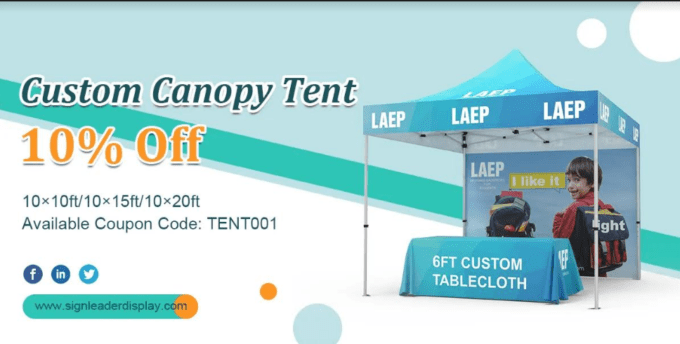
Anyone walking a busy exhibition floor cannot simply ignore vibrant, mesmerizing visuals. A custom canopy tent dressed in striking colors and clear branding will naturally attract far better foot traffic than a plain, unbranded shelter. Designing a pop up tent requires careful planning, but the payoff is immense once you see visitors stopping by. When you successfully build a high quality tent, you unlock potent marketing ammunition for trade shows, outdoor business events, or community celebrations.
Most modern manufacturers supply both the hardware and full design assistance to decorate every square inch of the canopy. While they often charge an initial design fee, this service eliminates the headache of figuring out complex bleed lines and template proportions on your own. Signleader Display remains a reliable partner ready to offer top tier production services for your business. Beyond pop up tents, their extensive catalog features promotional flags, table covers, and trade show displays.
If you prefer mapping out the creative details yourself, you will need a solid grasp of the fundamentals before placing an order. We have gathered essential tips around 10×10 custom tent creation to give your promotional strategy a fresh start for 2026. For a deeper look at industry standards, you can read this comprehensive canopy buying guide to understand how different fabric weights and frame materials hold up outdoors.
Tips to Customize Your Custom Canopy Tent
Pick Promising and Top-Rated Companies
If you choose to work with professional manufacturers for your next outdoor setup, make sure the provider meets a few strict standards. First, look for a supplier that offers a streamlined ordering process so you do not waste hours submitting artwork. On-time delivery is an absolute must because missing your event date renders the entire marketing investment useless. Additionally, verify that they offer fully custom options for both the roof and valance panels.
Other practical aspects like competitive pricing or responsive customer support should be weighed closely during your selection process. Before moving forward with a standard custom 10×10 tent, you need to have your vector artwork finalized and ready for submission. Taking time to vet your manufacturer prevents costly production delays down the road.
Create a Clear Logo
Every image on a high resolution computer monitor looks crisp and fantastic without a doubt. The trouble usually begins when that artwork is printed onto heavy fabric banners or outdoor canopy tops, resulting in pixelated or blurry graphics. Identifying the root cause of this blurriness is the first step toward professional branding. As you weigh various marketing investments, you might also consider how to evaluate digital platforms for managing your broader business budget.
The primary thing you must check is whether your logo file is saved as a true vector graphic. Unlike standard raster images, vector files rely on mathematical formulas rather than fixed pixels. This format guarantees that your artwork retains absolute sharpness when printed, even if workers scale it up to cover a massive tent peak. Thus, your logo must be converted to vector paths before applying it to customized tents.
Common vector formats include .ai files from Adobe Illustrator, scalable .pdf files, or traditional .eps formats. If your current graphic files are low resolution jpegs or pngs, take time to have a designer vectorize them properly. This simple upgrade ensures your brand looks polished and authoritative at every live event.
Eye-Catching Logo and Color Choices
Designing a visually striking logo for a custom tent takes deliberate effort, but a few proven industry practices make the process easier. First, rely on Pantone matching system colors to maintain exact color consistency across all promotional items. Professional manufacturers and printers widely use Pantone swatches because they eliminate guesswork in high end fabric printing.
When finalizing colors for your 10×10 canopy tent, utilizing Pantone codes yields much more reliable results than standard CMYK mixes. Pigments from CMYK profiles can absorb differently depending on whether your canopy fabric is polyester, vinyl, or canvas. Pantone swatches feature fixed formulations designed to bond cleanly with a wide variety of outdoor textiles. While managing your business logistics, you may also want to research how to coordinate heavy freight shipping if you are ordering multiple display booths at once.
You can generally choose between two primary printing methods: screen printing and dye sublimation digital printing. Screen printing works well for basic logos featuring one or two solid colors on standard backdrops. Most modern brands opt for digital dye sublimation printing to accommodate complex, multi-colored designs that make a 10×10 event tent truly unforgettable.
Frequently Asked Questions
What size custom canopy tent is best for most trade shows?
A standard 10×10 custom canopy tent is the most popular choice because it fits standard 10×10 trade show booths while offering plenty of space for staff and visitors.
What is the difference between vector and raster logo files?
Vector files use math equations to maintain crisp edges at any scale, while raster files use pixels that blur and distort when enlarged on large fabric canopies.
Why should I use Pantone colors instead of CMYK?
Pantone colors provide a universal matching system that ensures your brand colors look identical across different fabrics, avoiding unpredictable shifts caused by CMYK printing.
How long does a custom canopy tent typically last?
With proper care, storage, and securing against wind, a commercial grade custom canopy tent made from high denier fabric can last for several years of frequent event use.
Should I use digital printing or screen printing for my tent?
Digital dye sublimation is ideal for complex, multi-color logos and full-bleed graphics, while screen printing suits simpler designs with one or two solid colors.